


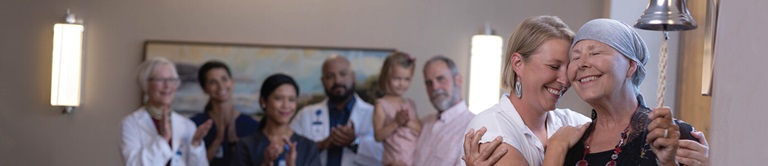
A Breast Cancer survivor ringing a bell while being encouraged by doctors and family

Breast Cancer

Comprehensive breast cancer care

Breast health concerns and breast cancer diagnoses can feel overwhelming.

You’re not alone. At Marshfield Clinic, our specialists come together to guide you every step of the way. From your very first question and screenings through treatment and recovery, we’re here for you. 


Contact us for care

Call (866) 520-2510 MondayFriday 8 a.m.5 p.m.

Request an appointment


Breast cancer risk

Your breast health is unique. Care should be too. That’s why we consider your age, family history, genetics and lifestyle when determining your breast cancer screening plan and whether you’re high risk. 

Your breast cancer screening conversation should start with your primary care provider, who can help you schedule your first mammogram.

To calculate your breast cancer risk, your provider will consider factors like:

  • Your biological sex and age
  • Personal or family history of breast cancer
  • Inherited gene mutations (BRCA1, BRCA2)
  • Dense breast tissue
  • Early menstruation or late menopause
  • Obesity, especially after menopause
  • History of chest radiation therapy
  • Long-term hormone replacement therapy
  • Alcohol use
  • Physical inactivity

We offer a high-risk breast service for more guidance on your breast cancer risk.


Breast cancer signs and symptoms

Breast cancer screening is the best way to detect cancer early.

Outside of screening, some women notice new signs and symptoms of breast cancer like:

  • A breast or underarm lump or thickening
  • Changes in breast shape or size
  • Skin dimpling (like an orange peel)
  • Nipple retraction (turning inward)
  • Scaling or thickening of the breast or nipple
  • Nipple discharge (other than breast milk)
  • Rapid swelling
  • Skin warmth or redness

Make an appointment as soon as you notice changes in your breast health.

Existing Marshfield Clinic patients can sign in to their online patient account to schedule an appointment.

Anyone can call (866) 520-2510 or fill out an appointment request form.

Find a doctor

Breast cancer treatments

Surgery and reconstruction

Before breast surgery or reconstruction, your care team will consider your cancer stage, location and size. In a lumpectomy, the cancer is surgically removed. In a mastectomy, the entire breast is removed. In reconstruction, the entire breast is removed and then recreated with an implant or tissue.

Radiation therapy

Radiation therapy uses high-energy beams to kill cancer cells and reduce recurrence. Often, this treatment is recommended after lumpectomy and, in some cases, mastectomy.

Chemotherapy

Chemotherapy can help stop the growth of cancer cells. Sometimes chemotherapy is given before surgery. Other times it’s given after surgery. Your care team will help develop a treatment plan right for you.

Hormone therapy

Hormone therapy is used for cancers that rely on estrogen or progesterone to grow. In these instances, hormone therapy can help prevent recurrence.

Targeted therapy

Targeted therapy is a cancer treatment that focuses on specific changes in cancer cells, like in HER2-positive breast cancer.

Types of breast cancer

There are many types of breast cancer. We work together to learn what makes you and your breast cancer unique. This helps us tailor treatment to fit the complexities of your life and diagnosis.

Marshfield Clinic treats common breast cancers:

  • Ductal carcinoma in situ (DCIS): A very early, noninvasive cancer contained within the milk ducts.
  • Invasive ductal carcinoma (IDC): The most common breast cancer, starting in the milk ducts and spreading into nearby tissue.
  • Invasive lobular carcinoma (ILC): May be harder to detect. Begins in milk producing lobules and can involve both breasts.

We also treat rare breast cancers:

  • Inflammatory breast cancer: Rare and aggressive. Causes rapid swelling and skin changes.
  • Paget's disease of the breast: Rare cancer involving the nipple and areola.
  • Male breast cancer: Uncommon but possible because all people have breast tissue.
 

Learn more