



Providers in a pharmacy

Pharmacy Year 1 Residency

PGY-1 pharmacy residency overview

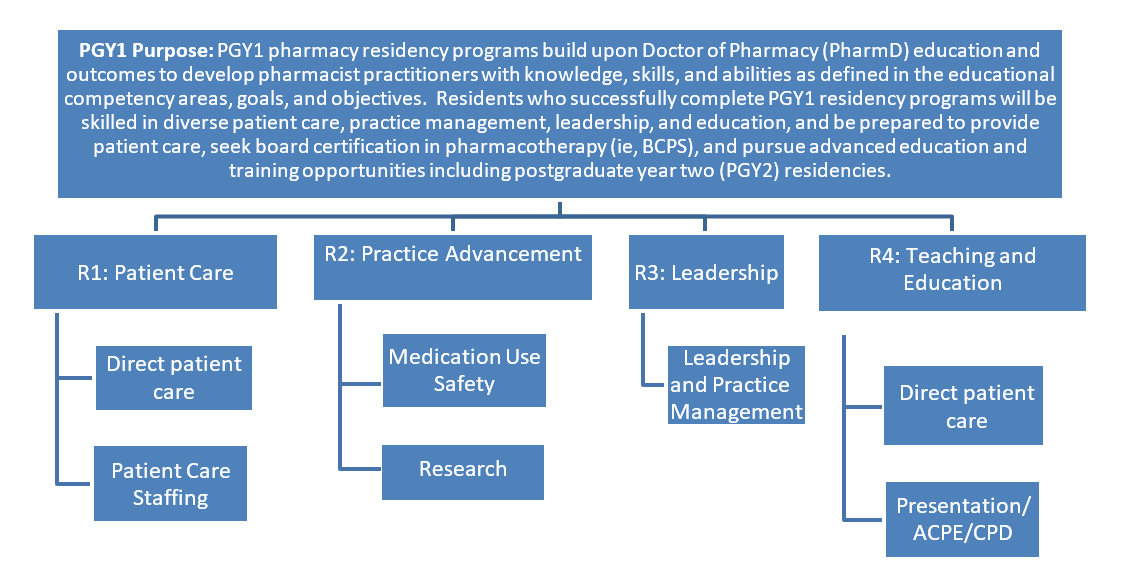
The PGY1 Pharmacy Residency Program Curriculum has been formed with the goal of fulfilling four ASHP competency areas.  These competencies have been defined by ASHP as the specific knowledge, skills, behaviors, attitudes, and educational experiences that a resident must demonstrate in order to be considered as having completed a graduate pharmacy education program. The pharmacy residency program will develop in its residents these competencies to the level expected of a new practitioner.
Program structure

The program consists of a series of required and elective educational experiences, including rotations and longitudinal experiences.  The Pharmacy Residency Program Curriculum has been developed with the goal of fulfilling the required competency areas. 

View our program structure.

Program purpose statement

PGY1 pharmacy residency programs build upon Doctor of Pharmacy (PharmD) education and outcomes to develop pharmacist practitioners with knowledge, skills, and abilities as defined in the educational competency areas, goals, and objectives.  Residents who successfully complete PGY1 residency programs will be skilled in diverse patient care, practice management, leadership, and education, and be prepared to provide patient care, seek board certification in pharmacotherapy (ie, BCPS), and pursue advanced education and training opportunities including postgraduate year two (PGY2) residencies.

Program competency areas

The four required competencies of the PGY1 Pharmacy Residency program include:

  1. Patient care
  2. Practice advancement
  3. Leadership
  4. Teaching and education
PGY1 Competencies Chart 

Required Learning Experiences

View our required learning experiences.

Acute track residents may complete 0-1 ambulatory direct patient care electives

Ambulatory track residents may complete 0-1 acute direct patient care electives

Direct Patient Care Electives

Program information

Sample Schedule Outline

How Rotations are Typically Sequenced

The following sequencing principles are generally utilized:

  • Direct Patient Care Training is completed prior to longitudinal staffing responsibilities.
  • Internal Medicine (Acute) is typically completed prior to acute care elective experiences.
  • Internal Medicine (Ambulatory) is typically completed prior to ambulatory care elective experiences.
  • Acute Care Track residents may complete up to one ambulatory care elective.
  • Ambulatory Care Track residents may complete up to one acute care elective.
  • Elective experiences may be modified based upon resident interests, development plan needs, and career goals with approval from the RPD and RAC.

Required Longitudinal Experiences

Direct Patient Care Longitudinal (9 total weeks)

Acute Care Track

  • Every fourth week (Monday through Sunday)
  • Marshfield Medical Center Inpatient Pharmacy

Ambulatory Care Track

  • Every fourth week (Monday through Sunday)
    • Internal Medicine Transition Care Clinic (Mon-Friday)
    • Marshfield Clinic Pharmacy (Saturday, Sunday)

Requirements

  • Nine weeks during the residency year, starting as soon as September
  • One holiday staffing shift 
  • Up to 40 hours of additional staffing annually, if needed

Leadership/Practice Management Longitudinal (12 months)

Topic Discussions with preceptors and program director will occur throughout the residency year as scheduled (10 minimum). These discussions may include, but are not limited to:

  • SBAR Communication
  • Strategic Planning
  • Time Management
  • Recruitment/Pharmacy Career Fairs/Interview Process
  • Change Management
  • Budget Process Review: Capitol Budgets, Operating Budgets
  • Conflict of Interest/Ethical Dilemmas
  • 797 and Chap 15 WI Admin Code
  • Supply Chain
  • Professionalism/Ethics
  • ACCP Position Statement: Pharmacists and Industry: Guidelines
  • Pharmacy Systems Manager Meetings
  • Giving effective feedback
  • Pharmacy Reimbursement and Finance/Finance Management
  • Corporate Athlete
  • Conservative Prescribing
  • Pharmacy Forecast
  • Team Building

Monthly Meetings with Program Director

  • Leadership/Practice Management related topic discussion at Weekly Meeting with Program Director including reading and discussing the following books:  Strength Finder 2.0, Eat that Frog- Quarter 1, 'Who Moved My Cheese'- Quarter 2
  • Myers-Briggs Type Indicator Personality is an optional additional activity to supplement Strength finder discussion: https://www.16personalities.com/
  • One additional leadership reading of resident's choice (e.g., 'Good to Great' by Jim Collins, 'Hardwiring Excellence' by Quint Studer) which will occur during Quarter 3 or Quarter 4 of residency.

Presentation/ACPE/CPD Longitudinal (12 months)

  • Continuing Pharmacy Education (CPE) involvement x 12 months
  • Attend Pharmacy CE presentations and may present as part of current rotation requirements
  • Community Involvement will include, but is not limited to:
    • Participation in Community Outreach at assisted living facility (at least once per 12 month residency as scheduled) to address questions the elderly population may have regarding medication therapy and conduct a 20 minute presentation on a Geriatric related topic.
    • Volunteer opportunities at St. Vincent's Free Clinic (optional)

Research Longitudinal (12 months)

  • Residents will select and complete a project during the residency year.
  • Some of the key components of this learning experience include:
    • Participate in the Resident Research Program (including completion of the Collaborative Institutional Training Initiative (CITI) program)
    • Attend at least 2 Institutional Review Board (IRB) meetings
    • Prepare Poster Presentation and present at National meeting (e.g., ASHP Midyear)
    • Wisconsin Resident Conference (WPRC) Project Presentation (April)
    • Marshfield Clinic Medical Education Day Project Presentation (May)
    • Attend and participate in pharmacy Journal Club
    • Complete research proposal
    • Complete manuscript draft prior to end of residency
    • AJHP Research Perspective Articles Discussion in SharePoint

Application criteria

Our application is a new two-part process

Part one 

The pharmacy residency program will be utilizing the PhORCAS (Pharmacy Online Residency Centralized Application Service) for the following application materials: 

  • Curriculum vitae (CV)
  • Official college transcripts from school of pharmacy
  • Three letters of recommendation
  • Personal Statement/Cover Letter

Part Two

Please fill out the Marshfield Clinic online application using the following directions:

  • We ask that you create UserID/Password, located at the top of the page. You will only have to create this UserID one time. You can then enter the site as often as you wish.
  • Once you are able to log in to the Employment Center web site. Search "Pharmacy Resident".  
  • Click on the link under Job Title to access the details of the Pharmacy Residency. Click on "Apply for this position" when ready to complete the online application.
  • Please be sure to answer the four open-ended questions at the end of the application form prior to submitting.  This application will take 10-15 minutes to complete. You may save your session and come back to it at a later time.

Any questions, please contact the Pharmacy Residency Program Director: 

Sara A. Griesbach, PharmD, BCPS, BCACP
Director, Clinical Pharmacy Services
PGY1 Pharmacy Residency Program Director
Marshfield Medical Center
1000 North Oak Avenue
Marshfield, WI 54449
1-800-782-8581 ext 19820 or 715-221-9820
Fax: 715-221-7880
Email Pharmacy Residency


​​​​​​​​​​​​​​​​​​​​Salaries & benefits

Salaries for 2026-2027  (effective July 1, 2026)

PGY-1  $58,214

2026 Benefits Summary

Faculty

Residents learn with close support from attending faculty who actively choose to teach as part of their role. Faculty provide frequent one-on-one guidance, allowing residents to benefit directly from their experience and expertise.

Faculty

  • Angela Brenner, PharmD, BCPPS
  • Blake Carley, PharmD
  • Eugene Eldridge, PharmD
  • Kristin Evans, PharmD, BCACP
  • Connie Folz, PharmD, BCPS
  • Sara Griesbach, PharmD, BCPS, BCACP
  • Jennifer L Grimm, PharmD, BCPS
  • Mary Ellen Gullickson, PharmD, BCPS, BCACP
  • Taylor L Gunderson, PharmD
  • Craig Irwin, PharmD
  • Tonja Larson, PharmD, BCPS, BCACP, BCGP
  • James Lokken, PharmD
  • Katie Morgan, PharmD, BCPPS
  • Sara R Pickett, PharmD, BCPS
  • Jaimee Pieper, PharmD
  • Timothy C Priefer, Pharm.D., MBA
  • Matthew Richardson, PharmD
  • Emma Robus, PharmD, BCPS
  • Emily Roland, PharmD, BCPS
  • Brian Ruppel, PharmD, BCACP
  • Sarah Solano, PharmD
  • Brian Sanford, PharmD
  • Katy Smith, PharmD, BCPS
  • Matt Thill, PharmD, BCCCP
  • Zachary A Wallace, PharmD, BCPS, CPHQ, CAHIMS
  • Phillip Whitfield, PharmD, BCIDP
  • Travis Witt, PharmD